

Review Finds Four EU Accessibility Act Fines in 15 Months, All in Czechia
The paragraph and the checkout: a review of 15 months of European Accessibility Act enforcement in all 27 EU countries.
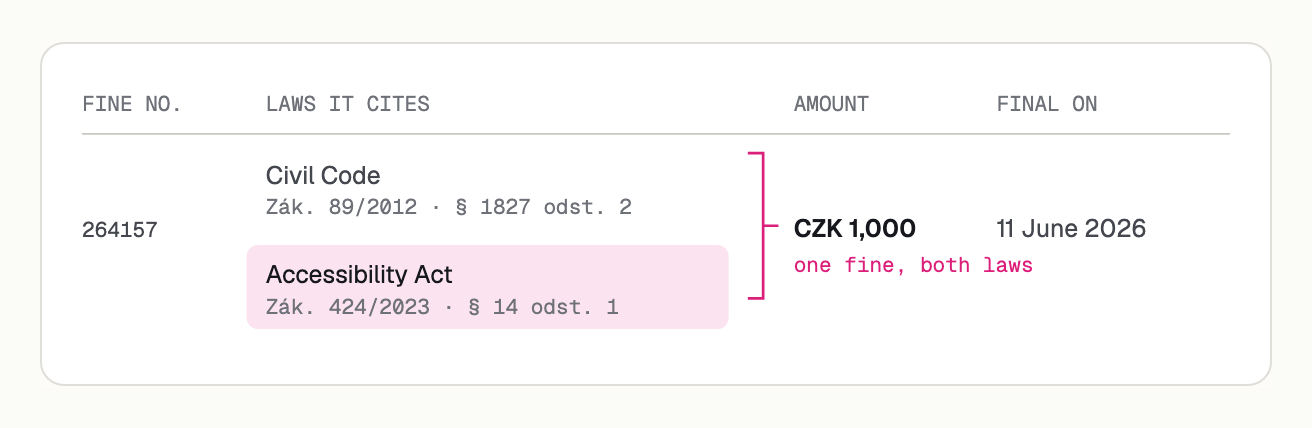
One of the four Czech fines as the official register lists it: a single CZK 1,000 sum covering a Civil Code breach and the accessibility-law paragraph.
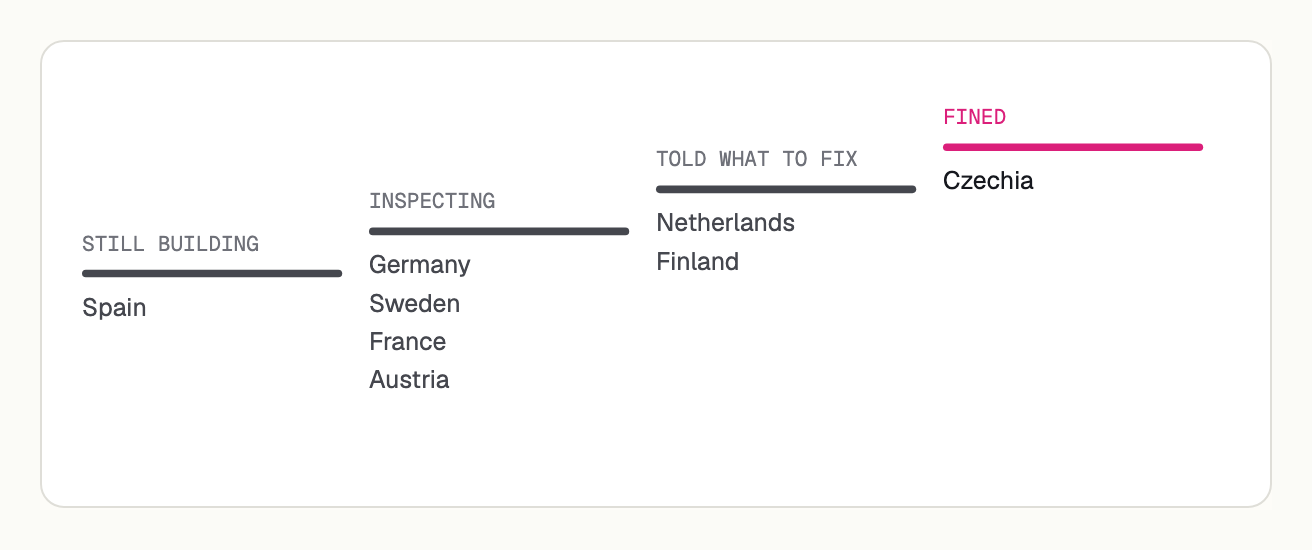
How far enforcement has got in the countries the review could assess, going by what each authority has published.
Four Czech fines, together about €580, cite a missing paragraph in shop terms. Dutch inspectors could not finish an order at 61% of large webshops.
Fifteen months into the European Accessibility Act, none of the fines on public record anywhere in the EU is for a checkout like that. That is the finding of a review by Peculiar Systems, an independent software studio, of what the authorities of all 27 member states have published since the law began to cover online shops on 28 June 2025.
The review found four fines, all in Czechia, together CZK 14,000, or about €580 (register numbers 261072, 263726, 263928 and 264157). Each one cites section 14(1) of the Czech accessibility law, which requires a shop to explain in its terms and conditions how its service is accessible. Each is also a single sum that covers other consumer-law breaches found in the same inspection, so how much of it was for accessibility cannot be told. The Czech Trade Inspection Authority publishes every fine it issues in a public spreadsheet, which currently runs to 29 June 2026.
The Dutch findings are not an outlier. France's consumer watchdog DGCCRF found accessibility problems at more than half of the shopping sites it checked this year, and Sweden's regulator PTS has opened cases against 28 large online shops since 2025.
Part of the slow pace is by design. Austria reported 84 cases in the law's first year and no fines. Finland's accessibility law contains no fines at all, and in Denmark only the police can impose one. In January, the European Commission warned nine member states that their national versions of the law were incomplete, including the rules on enforcement.
"Regulators read the terms first. Customers start at the checkout," the review concludes. "The accessibility paragraph in your terms takes a day, and it is the only thing anyone has been fined for. Then walk the way from your home page to a finished order with a keyboard and a screen reader. That is where the Dutch regulator got stuck, and where your customers already do."
The review has limits that the studio states openly. Most countries do not publish individual fines, so for them "no fines" means none that could be found. Latvia, Hungary and Slovakia do publish their decisions; none of them yet concerns the accessibility law. The studio's summary of each country's law, with links to the official texts, is published as open data, and the full review with a source for every figure is on the studio's website.
Peculiar Systems also makes ShopOffen, a free automatic accessibility check for online shops that sell in the EU. It reports findings against the EN 301 549 standard, checks the shop's accessibility statement and adds a self-check list, as a report in the browser, without sign-up. It is not a certificate and not legal advice.
About Peculiar Systems
Peculiar Systems is an independent software studio, a small team building narrow software for problems that large platforms overlook. More at peculiar.systems.
Peculiar Systems
Peculiar Systems
contact@peculiar.systems
Visit us on social media:
LinkedIn
Bluesky
Instagram
Legal Disclaimer:
EIN Presswire provides this news content "as is" without warranty of any kind. We do not accept any responsibility or liability for the accuracy, content, images, videos, licenses, completeness, legality, or reliability of the information contained in this article. If you have any complaints or copyright issues related to this article, kindly contact the author above.
