

New C-UP and UCFS Analysis Explores How Remesh Can Support Civic Participation in the Cyprus Peace Process

Remesh Logo
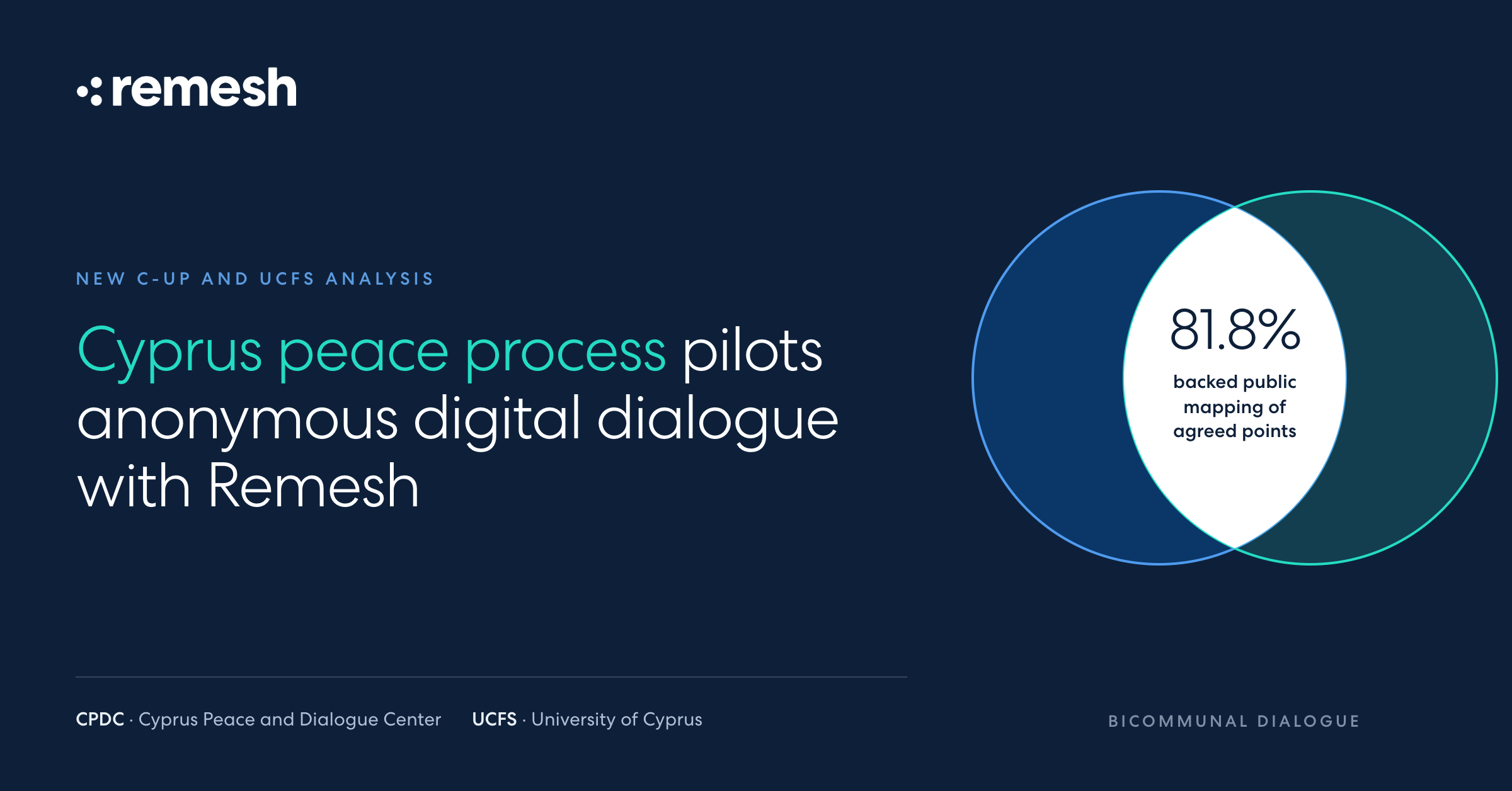
One C-UP process-design dialogue and two related University of Cyprus exercises tested anonymous digital participation across different formats and cohorts
The value of Remesh is not in manufacturing consensus, but in generating evidence that can inform more inclusive peace-process design.”
NICOSIA, CENTRAL NICOSIA DISTRICT, CYPRUS, September 28, 2026 /EINPresswire.com/ -- The Cyprus Peace and Dialogue Center (CPDC) today published an analysis of one C-UP process-design dialogue and two related University of Cyprus exercises conducted using the Remesh platform. The publication examines how anonymous digital participation may contribute to a more inclusive, transparent and effective Cyprus peace process.— Meltem Onurkan-Samani, Founding President and General Coordinator of CPDC
Written by Professor Charis Psaltis of the University of Cyprus, Dr Meltem Onurkan-Samani of CPDC and Professor Neophytos Loizides of the University of Warwick, the analysis examines lessons from these exploratory exercises for the design of inclusive civic participation in the Cyprus peace process. Findings from the C-UP dialogue informed a separate civic-participation proposal developed within the project.
The dialogues tested whether structured online deliberation can work in a society divided by language, geography and decades of low trust. Participants responded in their own language, in text, and voted on one another's contributions anonymously, with AI analyzing those responses to show where the group converged and where it split.
The three exercises were deliberately different. The C-UP exercise was a live, multilingual bicommunal dialogue on peace-process design. The two related University of Cyprus exercises comprised a larger asynchronous Greek-language dialogue on perceptions of resolving the Cyprus problem and a smaller dialogue with Greek Cypriot University of Cyprus undergraduates.
The process-design session found broad agreement on how negotiations should run. Public mapping of agreed points drew support from 81.8% of respondents, while staged confidence-building measures and a citizen-triggered Citizens' Council were each supported by 77.3%.
On substance, the picture was different. The larger perceptions dialogue showed sharp divergence across demographic segments, clustering around sovereignty and natural resources, external guarantees and troop withdrawal. Among the student cohort, 74.5% rejected a two-state solution and 71% accepted a Bizonal, Bicommunal Federation, which reflected broader trends observed over the years in bicommunal research of the University of Cyprus University Center for Field Studies available here.
Findings from the C-UP process-design dialogue informed the development of a two-tier civic-participation proposal within C-UP, adapted from Belgium's Ostbelgien system: a standing Civic Advisory Council alongside a rotating assembly of citizens selected by sortition, with an early assembly focused on process before substance.
The C-UP initiative was already under way when, in July 2025, the Greek Cypriot leader and the Turkish Cypriot leader reached a common understanding on establishing a consultative body for civil-society engagement. In January 2026, UN Security Council Resolution 2815 called upon them to form it. Building on this policy opening, members of the C-UP Technical Advisory Board subsequently developed a more detailed two-tier civic-participation proposal. (The proposal is set out in A Consultative Body for Deliberative Peacemaking, published on 13 March 2026 and available through SCORE for Peace: https://admin.scoreforpeace.org/storage/pdfs/PUB_Consultative-Body-Paper.pdf.). Based on the information announced to date, several elements of the emerging official framework appear consistent with features of the C-UP proposal. C-UP nevertheless remains institutionally separate from the official Consultative Body.
"Used carefully, anonymous and multilingual digital participation can show both where participants find common ground and where genuine differences remain. The value of Remesh is not in manufacturing consensus, but in generating evidence that can inform more inclusive peace-process design," said Dr Meltem Onurkan-Samani, Founding President and General Coordinator of CPDC and C-UP Lead.
“Compared to previous large scale representative surveys that we often used in the past we were in a position this time to reveal both qualitative depth and a quantitative sense of the weight of each nuanced position in specific populations. Scaling up with large scale representative samples is our next step and Remesh can handle this very well," said Professor Charis Psaltis, University of Cyprus, Director of the University Center for Field Studies.
These exploratory exercises were not designed to be representative. Remesh provided complimentary platform access for testing, and C-UP remains institutionally separate from the official Consultative Body.
A more in-depth analysis is available at remesh.ai.
About C-Up
C-Up (Updated Cyprus Peace Process Design, 2025-2027) is an EU-funded bi-communal initiative led by the Cyprus Peace and Dialogue Center with ICLAIM, funded under the Aid Programme for the Turkish Cypriot community. It pilots citizens' assemblies and structured deliberation as a complementary civic track to formal Cyprus peace negotiations, supporting the leaders rather than replacing them.
About the University Center for Field Studies (UCFS)
UCFS is a non-profit research infrastructure in the University of Cyprus. UCFS’ vision is to become a connecting bridge between the scientific community and the society in general by providing evidence-based recommendations in a way that enhances the diffusion of scientific knowledge and societal development in general.
About Remesh
Remesh is an AI-powered conversational research platform that helps organizations understand what large groups of people think, including customers, employees, and patients. Remesh runs human-moderated conversations with hundreds or thousands of participants at once, using AI and natural language processing to analyze open-ended responses in real time. That gives enterprise teams the depth of qualitative research at the speed and scale of a survey, without the sample limits of focus groups or the blind spots of closed-ended surveys. Remesh supports market research and employee research programs for enterprises worldwide. Learn more at https://www.remesh.ai/
Media Contacts
Hazal Ekin Dolu
CPDC
cpdc.communication@gmail.com
Charis Psaltis
UCFS
pakepe@ucy.ac.cy
Emma Borochoff
Remesh
hello@remesh.ai
Legal Disclaimer:
EIN Presswire provides this news content "as is" without warranty of any kind. We do not accept any responsibility or liability for the accuracy, content, images, videos, licenses, completeness, legality, or reliability of the information contained in this article. If you have any complaints or copyright issues related to this article, kindly contact the author above.
