

Humanoid Robot Market Surges from US$1.4 Bn to US$19.6 Bn | Persistence Market Research
humanoid robot market
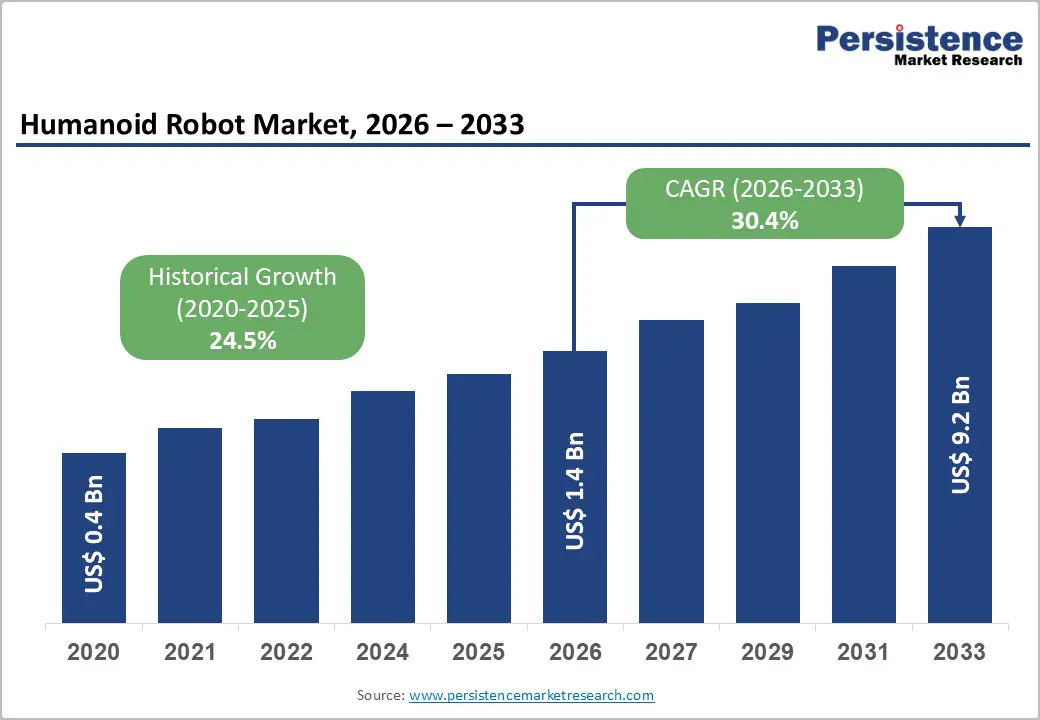
Humanoid robot market is expanding rapidly, driven by AI advances, automation demand, and growing adoption across industries and services.
LONDON, UNITED KINGDOM, February 23, 2026 /EINPresswire.com/ -- The global humanoid robot market is projected to be valued at US$ 1.4 billion in 2026 and is forecast to reach US$ 19.6 billion by 2033, expanding at a CAGR of 30.4% between 2026 and 2033. This rapid growth reflects a structural transformation in automation, as humanoid robots evolve from laboratory prototypes to commercially viable systems across manufacturing, healthcare, defense, logistics, and service industries. Industrial adoption is accelerating, with more than 800 million yuan in commercial orders already recorded for industrial humanoid platforms. Government procurement in China rose by 214% in 2024, signaling institutional confidence in large-scale deployment. Major funding rounds, including US$ 935 million secured by Apptronik, demonstrate strong investor conviction in scaling production of next-generation humanoid systems for industrial environments.
Download Your Free Sample & Explore Key Insights: https://www.persistencemarketresearch.com/samples/36200
Market Dynamics
Drivers: Skilled Labor Shortages and Automation Demand
Global manufacturing sectors face severe workforce shortages that are constraining productivity. In the United States alone, employers report nearly 2.9 million skilled trade openings annually, while only about 1.25 million qualified graduates enter the workforce, leaving a persistent gap. The Manufacturing Institute projects 2.1 million unfilled manufacturing roles by 2030. Globally, labor deficits could reach 85 million workers by 2030, representing trillions in unrealized revenue. According to the International Federation of Robotics, global industrial robot installations reached 541,000 units in 2023, with robot density rising to 162 units per 10,000 employees. Humanoid robots, capable of operating in human-centric environments without major infrastructure changes, are emerging as a flexible solution for machine tending, material handling, and logistics operations.
Technological Convergence of AI and Robotics
Advances in embodied AI, reinforcement learning, and vision-language-action models are eliminating barriers to humanoid deployment. Companies such as Boston Dynamics have partnered with Google DeepMind to integrate foundation AI models into Atlas humanoid robots, enabling perception, reasoning, and tool use. Similarly, Toyota Research Institute has demonstrated autonomous whole-body manipulation capabilities in collaboration with Boston Dynamics. These breakthroughs enable humanoids to adapt to dynamic industrial settings, reducing manual programming requirements and accelerating commercial viability.
Restraint: High Capital Investment
Despite strong momentum, high acquisition and operational costs remain barriers. Commercial humanoid robots can cost around US$ 100,000 per year under leasing models, excluding integration, maintenance, and infrastructure expenses. Total cost of ownership includes battery systems, enterprise software integration, and skilled technical support. While large enterprises can justify investment through productivity gains, smaller firms may delay adoption until economies of scale reduce pricing.
Opportunity: Large-Scale Commercial Deployment
The transition from pilot testing to fleet deployment represents a major opportunity. Agility Robotics has partnered with Mercado Libre to deploy Digit robots in logistics facilities, while UBTECH Robotics has secured significant industrial orders for its Walker S2 humanoid platform. Production-scale launches such as the fully electric Atlas from Boston Dynamics signal readiness for automotive and manufacturing environments. Recurring revenue from software updates, maintenance contracts, and analytics platforms further enhances long-term profitability for vendors.
Get Custom Insights Designed for Your Business: https://www.persistencemarketresearch.com/request-customization/36200
Category-wise Analysis
Locomotion Insights
Bipedal humanoid robots accounted for 59% of the market in 2026 due to their ability to navigate stairs, uneven surfaces, and confined industrial spaces. Their compatibility with human-designed infrastructure provides unmatched flexibility. Wheeled humanoids are gaining traction in structured warehouse settings where energy efficiency and speed are prioritized over terrain adaptability.
Level of Autonomy
Semi-autonomous robots hold 46% market share, balancing automation with human oversight. However, fully autonomous systems represent the fastest-growing segment, driven by AI maturity and sensor integration that enable independent decision-making in complex industrial environments.
Industry Insights
Industrial and logistics applications command 32% of total market share, supported by measurable ROI and productivity improvements. Defense and security represent the fastest-growing end-use segment, fueled by rising global defense budgets and strategic investments in advanced robotics.
Regional Insights
Asia Pacific dominates the humanoid robot market with an 85% share, driven by strong government backing, manufacturing strength, and capital investment across China, Japan, South Korea, and India. China alone has established extensive robotics funds and subsidies exceeding US$ 20 billion to accelerate innovation.
North America holds approximately 8% market share, supported by innovation ecosystems and leading developers such as Boston Dynamics, Agility Robotics, and Apptronik. High labor costs and automation initiatives among mid-sized manufacturers encourage deployment.
Europe accounts for around 4% share, emphasizing research-driven innovation and defense modernization. Companies like PAL Robotics contribute to advancements in service and bipedal robotics, strengthening regional capabilities.
Competitive Landscape
The humanoid robot market remains concentrated among technologically advanced players, including Boston Dynamics, Agility Robotics, UBTECH Robotics, PAL Robotics, and Unitree Technology. Strategic collaborations, large funding rounds, and AI integration are intensifying competition. As commercialization accelerates, partnerships and scalable production capabilities will define leadership in this rapidly evolving global market.
Checkout Now & Download Complete Market Report: https://www.persistencemarketresearch.com/checkout/36200
Market Segmentation
By Component Type
Hardware
Mechanical & Structural Systems
Actuation & Motion Systems
Sensing & Perception Hardware
Computer & Control Hardware
Power & Energy Systems
Software
AI & Autonomy Software
System & Middleware Software
Application Software
Services
Robot-as-a-Service (RaaS)
Integration & Deployment Services
Training & Support Services
Data & Optimization Services
By Locomotion Type
Bipedal Humanoid Robots
Wheeled Humanoid Robots
Hybrid
By Level of Autonomy
Fully Autonomous
Semi-Autonomous
Tele-Operated
By Industry
Industrial & Logistics
Commercial & Public Services
Healthcare & Assisted Living
Defense & Security
Residential / Consumer
Research & Education
Misc.
By Region
North America
Europe
East Asia
South Asia Oceania
Latin America
Middle East & Africa
Read More Related Reports:
Circadian Rhythm Sleep Treatment Market: Circadian Rhythm Sleep Treatment market to grow at 4.7% CAGR, rising from US$2.4 billion in 2025 to US$3.7 billion by 2032, up from 6.5% CAGR during 2025–2032.
Meniscus Repair Systems Market: The global meniscus repair systems market will reach US$952.5 million by 2032, with an 8.1% CAGR driven by R&D investments and rising chronic diseases.
Persistence Market Research
Persistence Market Research Pvt Ltd
+1 646-878-6329
email us here
Visit us on social media:
LinkedIn
Instagram
Facebook
YouTube
X
Legal Disclaimer:
EIN Presswire provides this news content "as is" without warranty of any kind. We do not accept any responsibility or liability for the accuracy, content, images, videos, licenses, completeness, legality, or reliability of the information contained in this article. If you have any complaints or copyright issues related to this article, kindly contact the author above.
